
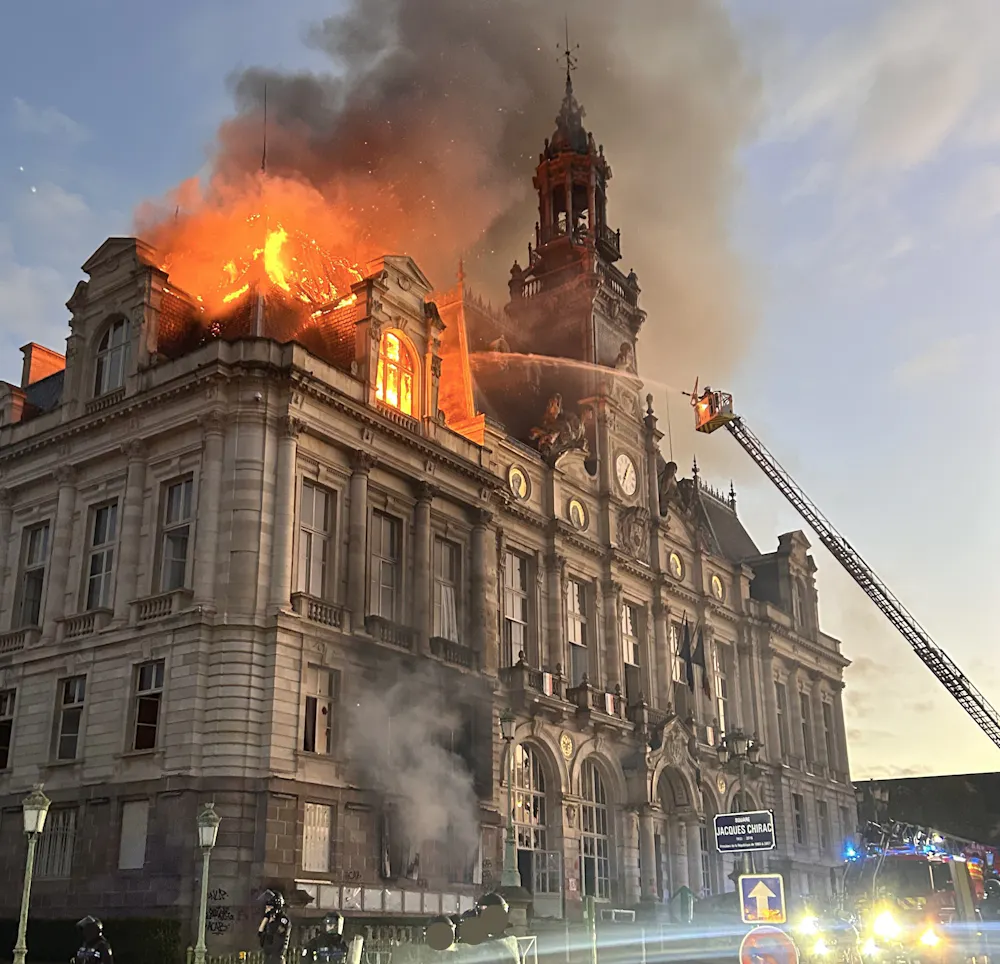
France is confronting a serious public-order crisis after violent unrest accompanying nationwide protests left shops looted, police officers injured and the historic town hall in Limoges devastated by fire. A 34-year-old man described by investigators and French media as a suspected ultra-left activist has been arrested in connection with the blaze, although his guilt has not been established. With further demonstrations expected on Saturday, 24 October, the French government is deploying 70,000 police and security personnel in an effort to prevent a repeat of the disorder. Euronews reported on the arrest; Reuters reported on the security operation.
The protests grew out of genuine concerns about the cost of living, school conditions and public services. But legitimate grievances do not excuse setting fire to public buildings, looting businesses or attacking police officers. France’s immediate challenge is to protect the public, preserve the right to peaceful protest and ensure that those responsible for criminal acts face the law.
The destruction in Limoges has become a stark symbol of what happens when political demonstrations are exploited by violent groups. A historic civic building has been lost, local businesses have suffered and public resources have been diverted towards restoring order.
Limoges town hall: a historic building destroyed
Limoges, central France – 17 October 2026
The fire at Limoges town hall, known as the Hôtel de Ville, was among the most serious incidents during the unrest. The building, inaugurated in 1883, was engulfed by flames after individuals entered it during the demonstrations. Its roof and bell tower collapsed, leaving the historic structure severely damaged.
The building’s destruction is a major loss for the city. A town hall is not simply an administrative office: it represents local government, civic life and the shared history of the community it serves. Residents who had no part in the violence are left to live with the consequences.
According to reporting by Euronews, French authorities arrested a man on 20 October in connection with the suspected arson. Anti-terrorism police were also involved in the investigation. The case is being treated seriously because of the scale of the damage and the circumstances surrounding the fire.
The incident was not the only attack on public property during the unrest. Reports described damage to municipal buildings and police facilities in several French cities, alongside fires, looting and confrontations with law enforcement.
The central question is not whether people should be permitted to protest government policy. They should. It is whether a democratic society can tolerate organised violence against public institutions and private property under the cover of political protest. It cannot.
Watch: the fire at Limoges town hall
The following video relates to the fire that devastated the historic building.
Suspect arrested as investigators examine possible far-left links
French authorities arrested a 34-year-old man on 20 October in connection with the Limoges town hall fire. Reporting by Euronews and Le Monde described the suspect as an activist associated with the ultra-left. Investigators are examining the circumstances of the blaze and the suspect’s alleged involvement. Read Le Monde’s report on the suspect.
The arrest is a significant development, but it is not a conviction. The suspect remains entitled to the protections of the French legal system, and the evidence must be tested through the appropriate process. Reporting about a person’s political associations must not be confused with proof that they committed a particular offence.
Nevertheless, the investigation raises legitimate questions about the role of radical activist networks in violent disorder. Where individuals or groups deliberately target public institutions, encourage attacks or use demonstrations as cover for serious criminal acts, their conduct deserves close scrutiny.
Political activism does not place anyone above the law. Nor should a person’s political cause provide a shield against investigation when credible evidence points towards criminal behaviour.
Authorities must establish who started the fire, whether others assisted and whether the incident was part of a wider plan. Any prosecution should be based on evidence, not political assumptions.
Macron condemns violence as France faces a public-order test
President Emmanuel Macron condemned the destruction and the wider violence following an emergency meeting with senior officials. His government has promised that those responsible for arson, looting and attacks on public buildings will face prosecution.
Macron’s message was that the right to demonstrate does not extend to destroying property or attacking the institutions of the Republic. That is a basic principle of democratic government, not an argument against peaceful dissent.
Interior Minister Laurent Nuñez has also warned that radical groups and looters have exploited the unrest. On 23 October, he said the authorities would take a firm approach to violence and prepare for further attempts to target public buildings. Reuters reported that the government planned to deploy 70,000 police and security personnel nationwide for the following day’s demonstrations.
The state has a clear responsibility to protect people going about their lives, businesses trying to trade and public servants carrying out their work. When streets become unsafe and civic buildings burn, restoring public order is not an optional political preference.
At the same time, the authorities must distinguish between peaceful demonstrators and people committing offences. Restrictions on protest should be lawful and proportionate, and police powers must be exercised within the law. A firm response to violence is compatible with protecting civil liberties; indeed, the two should reinforce one another.
Far-left extremism must not be excused as ordinary protest
The Limoges fire has intensified scrutiny of radical-left activism in France. French officials have accused ultra-left groups of encouraging disorder and exploiting demonstrations to attack public institutions. The suspect arrested in connection with the fire has also been described in reporting as an ultra-left activist.
Those allegations warrant investigation. They do not, by themselves, prove that every protester, trade unionist or left-wing political supporter was involved in the violence.
The demonstrations brought together people with different concerns, including students, trade unionists, former Yellow Vest supporters and citizens angry about the cost of living. Many attended peacefully. Their participation should not be treated as evidence of criminal conduct.
But the opposite mistake must also be avoided: the presence of peaceful demonstrators does not make violent activity less serious, and a movement’s stated political aims do not excuse the actions of those who burn buildings or attack police.
Political labels should be used carefully and consistently. Where evidence identifies far-left or far-right extremist networks, reporting should say so and explain the basis for the description. The same standards must apply regardless of whether a group’s ideology is fashionable, electorally influential or sympathetic to a particular journalist.
The essential distinction is between peaceful political participation and the deliberate use of violence to intimidate opponents or damage institutions. A free society must protect the former and hold perpetrators of the latter accountable.
What triggered the protests?
The demonstrations developed from student protests over school conditions before expanding into a wider movement addressing living costs and public services.
Students and education unions have raised concerns about teacher shortages, overcrowded classrooms, inadequate facilities and insufficient resources. Other participants have voiced frustration about household expenses, fuel prices, wages, pensions and the perceived deterioration of public services.
These concerns should be examined on their merits. Governments have a duty to explain how public money is spent, whether essential services are meeting people’s needs and what practical measures can ease pressure on households.
But a serious debate about economic policy requires more than anger in the streets. It requires evidence, workable proposals and accountability for decisions. Arson and looting contribute nothing to that process.
The Yellow Vest movement, which emerged in 2018 over fuel costs and wider economic grievances, has also become part of the broader political background. Trade unions, students and political activists do not necessarily share the same priorities, even when they take part in the same demonstrations.
It is therefore misleading to treat the unrest as a single movement with one motive. Equally, it would be wrong to ignore the violent fringe simply because other participants have legitimate complaints.
France must address real public concerns without allowing those concerns to become a licence for criminality.
Hundreds of thousands demonstrated, but participation is not guilt
French authorities estimated that approximately 550,000 people took part in demonstrations on 17 October, while organisers put the figure at around 800,000. The unrest included violent confrontations, property damage and looting, but not every person who joined a march participated in those acts.
That distinction matters for both public safety and fair reporting. Peaceful assembly is a democratic right, and people should not be collectively blamed for offences committed by others.
However, large crowds can create opportunities for masked groups and opportunistic offenders to operate amid confusion. When individuals use a protest as cover to attack officers, break into shops or set fires, authorities must be able to identify and arrest those responsible.
In Paris, reports described confrontations involving masked protesters who threw objects and fireworks, with police responding using crowd-control measures. Other cities also experienced damage and violence.
The resulting disruption affected more than the immediate targets. Shop workers, business owners, residents, emergency services and taxpayers all bear costs when public disorder spreads.
The right to protest should be protected. So should the rights of people who want to go to work, run a business, use public transport or live safely in their own neighbourhoods.
Police officers and demonstrators injured
The unrest has left police officers and members of the public injured. Authorities in Marseille reported 107 police officers injured, including three described as very seriously injured. These figures underline the risks faced by officers responding to violent crowds.
There have also been reports of serious injuries to young protesters involving police crowd-control weapons. Those incidents deserve proper investigation, including scrutiny of whether the force used was lawful, necessary and proportionate.
Public order cannot be maintained by treating every demonstrator as a threat. Nor can the dangers faced by police be dismissed when officers are attacked while trying to protect people and property.
The correct standard is accountability on all sides. Individuals who assault officers or damage property should be investigated and prosecuted where evidence supports charges. Police conduct should likewise be examined where there is credible evidence of misconduct.
A lawful state must be capable of both enforcing the law and obeying it. Neither responsibility cancels out the other.
Is immigration responsible for the unrest?
The disorder has prompted political arguments about immigration and integration. US President Donald Trump used the events to criticise France’s immigration policies, while Vice-President JD Vance made broader arguments about integration and social cohesion in Western countries.
Those arguments are part of a wider debate, but the evidence presented about the Limoges fire and the October unrest does not establish immigration as the cause of the violence. French authorities have publicly focused on suspected radical activists, looters and other offenders.
It is legitimate to debate immigration levels, border enforcement, integration policy and the obligations of governments to maintain public safety. Those questions should be addressed using reliable evidence, not assumptions about the background of people involved in a particular incident.
Where a suspect’s identity, immigration status or motive is relevant and verified, it can be reported. Where it has not been established, it should not be invented or implied.
The same standard applies to claims that political extremism, economic hardship or policing caused a particular act. The explanation must fit the evidence.
France’s immediate task is to identify the people responsible for specific offences and prevent further violence. Broader policy debates should not be used as substitutes for establishing individual responsibility.
Political tensions deepen ahead of the 2027 election
The unrest comes amid mounting political tensions ahead of France’s 2027 presidential election. President Macron’s government faces criticism from both right-wing and left-wing opponents, but the parties disagree sharply over the causes of the crisis and the appropriate response.
Marine Le Pen and other figures on the right have criticised the government’s handling of public order. Jean-Luc Mélenchon and representatives of La France Insoumise have challenged the government’s response and rejected attempts to assign collective blame to their movement.
The crisis may make public safety, economic policy, policing and the government’s ability to maintain order more prominent in the election debate. It is too early, however, to predict which parties will ultimately benefit.
One principle should not be controversial: political pressure must not be imposed through intimidation or violence. Elections, public debate, courts and peaceful demonstrations provide democratic means of challenging government policy. Burning a town hall does not.
The government’s response will be judged not only by whether it prevents further disorder, but also by whether it enforces the law fairly and addresses legitimate public concerns.
France deploys 70,000 police for further demonstrations
French authorities prepared a major security operation for Saturday, 24 October, after the previous weekend’s violence. Reuters reported on 23 October that approximately 70,000 police and security personnel would be deployed nationwide, supported by specialist units and equipment including helicopters, drones, mounted police and armoured vehicles.
The operation reflects concern that further demonstrations could be exploited by groups seeking confrontation or renewed looting. Some demonstrations have faced restrictions or bans, while cultural institutions and businesses have taken precautionary measures.
The authorities face a difficult balance. If they fail to protect people and public property, confidence in the state’s ability to maintain order will suffer. If restrictions are too broad or policing is disproportionate, the government risks undermining the civil liberties it is meant to protect.
The answer is not to abandon public order or to treat every protest as a threat. It is to plan carefully, act on credible intelligence, protect peaceful assembly where lawful and intervene firmly when violence or serious criminality occurs.
The investigation into Limoges town hall will remain an important test of whether those responsible can be identified and brought before the courts.
The verdict: protest is a right, arson is a crime
France’s unrest has exposed a serious challenge for a democratic state: how to respond when legitimate public grievances become entangled with violent disorder.
The concerns raised by students, workers and households deserve examination. Public services must be held to account, and peaceful protest must remain protected. But none of that excuses the destruction of a historic town hall, the looting of shops or attacks on police officers.
The arrest of a suspected ultra-left activist in connection with the Limoges fire is an important development, not proof of guilt. Investigators must follow the evidence, and the courts must determine responsibility. The same standard should apply to every suspect, regardless of political affiliation.
France should not have to choose between protecting civil liberties and enforcing the law. A functioning democracy requires both. Those who demonstrate peacefully should be able to do so without being tarred with the actions of violent groups. Those who commit arson, assault or looting should not be able to hide behind a political cause.
The destruction of Limoges town hall is a reminder of what is at stake when public disorder overwhelms civic life. Restoring order, protecting communities and holding offenders accountable are not attacks on democracy. They are among the responsibilities that make democracy possible.
Frequently asked questions
What happened at Limoges town hall?
The historic town hall in Limoges was engulfed by fire during unrest on 17 October 2026. Its roof and bell tower collapsed, causing severe damage to the building.
Has anyone been arrested over the fire?
Yes. French authorities arrested a 34-year-old man on 20 October in connection with the suspected arson. He has been described in media reporting as a suspected ultra-left activist. An arrest does not establish guilt, and the investigation must determine his alleged role.
Were the protests organised by the far-left?
The demonstrations included students, trade unions, former Yellow Vest supporters and other groups. French officials have accused radical far-left groups of encouraging or exploiting violence, but the wider protests also included peaceful demonstrators. Individual responsibility must be established through evidence.
What caused the demonstrations?
The protests grew from student concerns about school conditions and expanded to include wider grievances over living costs, wages, fuel prices and public services.
Is immigration proven to be responsible for the unrest?
No. Although US political figures blamed immigration, the available reporting does not establish immigration as the cause of the Limoges fire or the wider violence. Claims about individual offenders should be based on verified evidence.
How many police were deployed for the next protests?
French authorities announced plans to deploy approximately 70,000 police and security personnel nationwide on Saturday, 24 October, to help prevent renewed violence and looting.
Will those responsible face prosecution?
The French government has promised prosecutions for people responsible for arson, looting and attacks. Investigators must establish the evidence, and the courts must determine guilt through the legal process.